Top 20 Pharmaceutical Companies by Revenue & Market Cap in 2026: GLP-1, Oncology, and Blockbuster Drugs Driving Growth
Reviewed by: Frank Yap, MBA | Written by: Finance & Pharma Editorial Team | Originally published: July 2026 | Last Updated: August 8, 2026
📌 Quick Answer
Based on full-year 2025 results and Q2 2026 earnings reported through early August 2026, Johnson & Johnson ($94.2 billion FY2025 revenue; 2026 guidance just raised to ~$101.1 billion) remains the world's largest pharmaceutical/healthcare company by revenue, followed by China's Sinopharm Group (~$80 billion, primarily a distributor), Roche (~$70 billion), Eli Lilly ($65.2 billion FY2025, +45%; Q2 2026 revenue jumped 47.7% YoY to $22.97 billion, guidance now raised to $85–87 billion), Merck & Co. ($65.0 billion; Q2 2026 guidance raised to $66.3–67.3 billion), Pfizer ($62.6 billion; guidance raised to $60.5–62.5 billion), AbbVie ($61.2 billion; Q2 2026 revenue up 10.2% to $16.99 billion, guidance raised to ~$67.6 billion), AstraZeneca ($58.7 billion), Novartis ($54.5 billion) and Bristol Myers Squibb ($48.2 billion) rounding out the top 10. By market capitalization, Eli Lilly is far ahead of every rival at roughly $1.12 trillion as of early August 2026 — more than Johnson & Johnson's ~$620 billion.
The largest pharma companies in the world play a central role in global healthcare, developing blockbuster drugs for cancer, cardiovascular disease, immunology, vaccines, and metabolic disorders. This ranking ties together each company's audited FY2025 revenue with the freshest data point available — Q2 2026 earnings, which nearly every major drugmaker reported between late July and early August 2026 — so you're seeing both the annual leaderboard and how 2026 is actually shaping up so far.
Note: The global healthcare industry is much larger than Big Pharma. Check out: Largest Healthcare Companies by Country 2026.
Boosted by a 45% increase in full-year 2025 sales, Eli Lilly rose to become the industry's fourth-largest company by revenue — and its momentum has only accelerated since. The Indianapolis drugmaker's Q2 2026 print, released August 5, showed revenue up 47.7% year-over-year to $22.97 billion, prompting management to raise full-year guidance yet again, to $85–87 billion.
Update: For a broader field of 20 companies ranked side by side, see our companion piece, Top 20 Pharmaceutical Companies in the World: Revenue, Growth and Market Capitalization Leaderboard (2026).
On This Page

The largest pharma companies are defined not only by revenue, but by global scale, research investment, and therapeutic reach. These companies typically:
- Spend tens of billions annually on R&D
- Operate across the U.S., Europe, and emerging markets
- Control multiple blockbuster drug franchises
- Influence global drug pricing and treatment standards
As a result, the biggest pharmaceutical companies continue to shape the future of medicine, particularly in oncology, immunology, obesity, and chronic disease management.
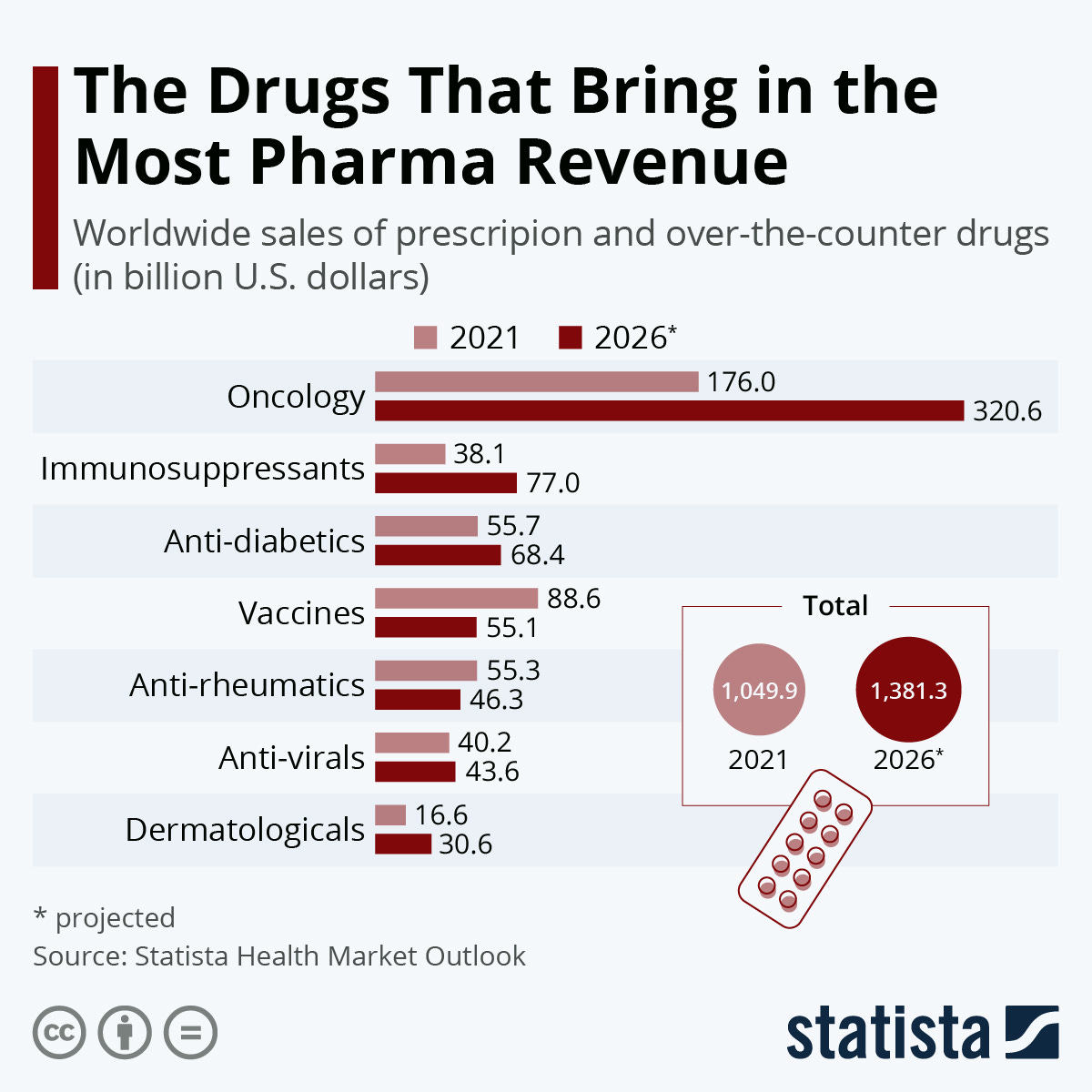
Out of the 10 projected best-selling drugs of 2025, four are GLP-1s. Novo Nordisk's semaglutide (Ozempic, Wegovy) and Lilly's tirzepatide (Mounjaro, Zepbound) generated more than $70B in combined 2025 sales.
Editor's note: For the purpose of this ranking, company revenues outside of the health sciences arena were excluded — for example, Bayer's crop science sales and Merck KGaA's electronics business. For companies reporting in foreign currencies, conversion to U.S. dollars is based on the annual average exchange rate for FY2025 figures; guidance and Q2 2026 figures reflect currencies as reported by each company.
2026 Top 20 Pharma Revenue & Market Cap Leaderboard
| Rank | Company | Ticker | HQ / Country | FY2025 Revenue | YoY Growth | Market Cap (Aug 2026) |
|---|---|---|---|---|---|---|
| 1 | Johnson & Johnson | NYSE: JNJ | USA | $94.2B | +6.0% | ~$620B |
| 2 | Sinopharm Group* | HKEX: 1099 | China | ~$80.0B (RMB 575.2B) | ~flat | ~$8.3B |
| 3 | Roche | SIX: ROG | Switzerland | ~$70B (CHF 61.5B) | +7% CER | ~$370B |
| 4 | Eli Lilly | NYSE: LLY | USA | $65.2B | +45% | ~$1.12T |
| 5 | Merck & Co. (MSD) | NYSE: MRK | USA | $65.0B | +1% | ~$322B |
| 6 | Pfizer | NYSE: PFE | USA | $62.6B | -2% | ~$150B |
| 7 | AbbVie | NYSE: ABBV | USA | $61.2B | +8.6% | ~$446B |
| 8 | AstraZeneca | NASDAQ: AZN | UK | $58.7B | +9% CER | ~$300B |
| 9 | Novartis | NYSE: NVS | Switzerland | $54.5B | +8% cc | ~$300B |
| 10 | Bristol Myers Squibb | NYSE: BMY | USA | $48.2B | Flat | ~$130B |
| 11 | Sanofi | NASDAQ: SNY | France | ~$47.5B (€43.6B) | +9.9% CER | ~$120B |
| 12 | Novo Nordisk | NYSE: NVO | Denmark | $43.3B | +10% CER | ~$210B |
| 13 | GSK | NYSE: GSK | UK | ~$42.8B (£32.7B) | +7% CER | ~$123B |
| 14 | Amgen | NASDAQ: AMGN | USA | $36.8B | +10% | ~$196B |
| 15 | Boehringer Ingelheim* | Private | Germany | ~$30.3B (€27.8B) | +7.3% | Private |
| 16 | Gilead Sciences | NASDAQ: GILD | USA | $29.4B | +2% | ~$178B |
| 17 | Takeda Pharmaceutical** | NYSE: TAK | Japan | ~$29.2B | ~flat | ~$55B |
| 18 | Teva Pharmaceutical | NYSE: TEVA | Israel | $17.3B | +4.3% | ~$38B |
| 19 | Regeneron Pharmaceuticals | NASDAQ: REGN | USA | $14.3B | +1% | ~$82B |
| 20 | Astellas Pharma** | NYSE: ALPMY | Japan | ~$13.5B | +varies | ~$29B |
↔ Swipe the table sideways to see all columns on mobile.
*Sinopharm Group is primarily a pharmaceutical and medical-device distributor/wholesaler rather than an R&D-driven manufacturer (see note below); Boehringer Ingelheim is privately held and discloses no market capitalization. **Takeda and Astellas report on a fiscal year ending March 31; figures reflect the closest comparable 12-month period to calendar 2025. Non-U.S.-dollar FY2025 figures are approximate conversions using average 2025 exchange rates. Market caps are approximate as of early August 2026 and fluctuate daily — verify against a live data source before use in investment decisions.
Q2 2026 Earnings Roundup
Calendar-Q2 2026 earnings season ran from late July through early August 2026, and it was a broadly strong one for Big Pharma: six of the top ten companies by revenue raised full-year guidance. Here's what moved:
- Johnson & Johnson — Q2 revenue rose 6.6% to $25.31 billion, with Innovative Medicine up 7.8% to $16.38 billion (Tremfya +72.5% to $2 billion). J&J raised full-year 2026 guidance to $100.8–101.4 billion in reported sales (midpoint $101.1 billion) and adjusted EPS of $11.60–11.75.
- Eli Lilly — Q2 revenue soared 47.7% year-over-year to $22.97 billion, with adjusted EPS of $8.38 beating consensus by 27%. Management raised full-year 2026 revenue guidance to $85–87 billion, and the stock rallied on the print — pushing market cap to roughly $1.12 trillion.
- Merck & Co. — Q2 revenue climbed 5% to $16.6 billion, beating consensus, with newly launched products more than doubling to $1.5 billion. Merck raised and narrowed full-year 2026 guidance to $66.3–67.3 billion, even while absorbing a $2.31-per-share charge tied to its $6.8 billion acquisition of Terns Pharmaceuticals.
- Pfizer — Q2 revenue reached $15.03 billion, with non-COVID revenue up 18% operationally. Pfizer raised the midpoint of full-year 2026 guidance by $500 million to $60.5–62.5 billion, unveiled $2.5 billion in additional 2027–2029 cost savings, and closed its Innovent Biologics transaction in July.
- AbbVie — Q2 revenue grew 10.2% to $16.99 billion. Skyrizi ($5.5 billion, +24%) and Rinvoq ($2.5 billion, +23.7%) keep outpacing Humira's decline. AbbVie raised full-year 2026 revenue guidance to roughly $67.6 billion and announced a planned acquisition of Apogee Therapeutics to bolster its dermatology and respiratory immunology pipeline.
- Novo Nordisk — Q2 adjusted sales grew 7% at constant exchange rates to DKK 78.5 billion. Management raised full-year 2026 guidance for the second time this year, to 0% to -6% adjusted growth (from -4% to -12%, itself an improvement on the -5% to -13% guidance that triggered a sharp February 2026 stock selloff). The oral Wegovy pill has now surpassed 5 million cumulative U.S. prescriptions, though U.S.-listed shares still fell after the print on continued pricing pressure.
- GSK — Core operating profit rose 7% in Q2 2026, extending the momentum from its FY2025 oncology and HIV franchise growth.
The net effect: the annual revenue ranking above is unchanged (it's based on closed FY2025 books), but the trajectory into the rest of 2026 has gotten noticeably stronger for J&J, Lilly, Merck, Pfizer, and AbbVie — and less bad for Novo Nordisk.
Largest Pharma Companies by Revenue (Global Ranking): Company-by-Company Breakdown
1. Johnson & Johnson — $94.2 Billion
Johnson & Johnson posted full-year 2025 reported sales growth of 6.0% to $94.2 billion. Oncology grew 22% within Innovative Medicine, with Darzalex crossing $14.3 billion and Carvykti nearly doubling to $1.9 billion, while Stelara biosimilar erosion cut Immunology revenue by roughly $4.3 billion. MedTech contributed $33.8 billion for the year. On the acquisition front, J&J's purchase of Intra-Cellular Therapies brought schizophrenia and bipolar treatment Caplyta into the fold; the drug scored a label expansion into major depressive disorder and generated $700 million in 2025 revenue. Near-term headwinds include generic and biosimilar erosion for Opsumit and Simponi, which together pulled down more than $2.8 billion in U.S. sales in 2025.
Q2 2026 update: J&J's momentum has carried into 2026 — Q2 revenue rose 6.6% to $25.31 billion, and the company raised full-year guidance to $100.8–101.4 billion, crossing the $100 billion mark for the first time. Market capitalization stood at roughly $620 billion in early August 2026.
5-Yr performance: +48% | P/E (TTM): ~29.9
2. Sinopharm Group — ~$80.0 Billion (RMB 575.2 Billion)
Sinopharm Group, a core subsidiary of China National Pharmaceutical Group, reported 2025 group revenue of RMB 575.2 billion (roughly $80 billion). Sinopharm is China's largest wholesaler and retailer of drugs and medical devices, serving more than 700,000 institutional customers, with distribution making up over 70% of revenue. Despite the enormous top line, its market capitalization is only around $8.3 billion — a reflection of the thin margins typical of distribution businesses rather than the high-margin, IP-driven economics of drug manufacturers.
Readers researching this ranking should understand an important structural distinction: Sinopharm is a pharmaceutical and medical-device distributor — the Chinese equivalent of McKesson or Cardinal Health — not an R&D-driven manufacturer like the other 19 companies here. That business model explains why its ~$80 billion in revenue would rank it second on this list by top-line sales alone, yet its market cap is smaller than that of companies with a fraction of its revenue, such as Regeneron ($14.3 billion in revenue, ~$82 billion market cap). Revenue-based rankings that include distributors like Sinopharm should be read separately from R&D-intensive manufacturer rankings, since margins, pipelines, and patent economics aren't comparable across the two models.
3. Roche — ~$70 Billion (CHF 61.5 Billion)
Roche reported group sales of CHF 61.5 billion for 2025, up 7% at constant exchange rates (2% in Swiss francs, reflecting a strong franc). The Pharmaceuticals Division grew 9% CER to CHF 47.7 billion, led by five core growth drivers — Phesgo, Xolair, Ocrevus, Hemlibra, and Vabysmo — which together added CHF 21.4 billion. Xolair was the standout at +32% on a new food-allergy indication. Roche has declared an ambition to become a top-3 global obesity company by 2030 and reported competitive Phase 2 obesity data for its candidate CT-388 in early 2026.
4. Eli Lilly and Company — $65.2 Billion
Eli Lilly delivered the industry's standout year in 2025, with revenue of $65.2 billion, up 45%. Mounjaro nearly doubled to $23.0 billion and Zepbound surged 175% to $13.5 billion — together delivering $36.5 billion, more than the entire annual revenue of Gilead or Amgen. Lilly's oral GLP-1 pill orforglipron (branded Foundayo) won FDA approval in April 2026, and the company's market cap crossed $1 trillion in November 2025.
Q2 2026 update: Lilly's Q2 2026 results, released August 5, showed revenue up 47.7% year-over-year to $22.97 billion and adjusted EPS of $8.38 — beating consensus by roughly 27%. Management raised full-year 2026 guidance to $85–87 billion, and the stock jumped nearly 5% on the print. Market cap sat at approximately $1.12 trillion in early August 2026, keeping Lilly the world's most valuable healthcare company by a wide margin. A drug-pricing deal struck with the White House in 2025 and Chinese Mounjaro coverage for type 2 diabetes remain the main variables management flags as pricing headwinds for tirzepatide going forward.
5-Yr performance: +352% | P/E (TTM): ~39.7
5. Merck & Co. (MSD outside the U.S. and Canada) — $65.0 Billion
Merck's total worldwide sales reached $65.0 billion in 2025, up 1%. Keytruda (pembrolizumab) grew 7% to $31.7 billion and now represents roughly 49% of total revenue, intensifying pressure to diversify ahead of its approximately 2028 patent cliff. Gardasil fell 39% to $5.2 billion on weak China and Japan demand, while newer launches Winrevair ($1.4 billion) and Capvaxive ($759 million) are emerging as diversification pillars.
Q2 2026 update: Merck's Q2 revenue climbed 5% to $16.6 billion, ahead of consensus, with newly launched products more than doubling year-over-year to $1.5 billion. The company raised and narrowed full-year 2026 guidance to $66.3–67.3 billion — even as it absorbed a $2.31-per-share charge tied to its $6.8 billion acquisition of Terns Pharmaceuticals, an early diversification move ahead of the Keytruda cliff.
6. Pfizer — $62.6 Billion
Pfizer's 2025 revenue came in at $62.6 billion, down roughly 2%, as COVID-19 products Comirnaty and Paxlovid continued to normalize. Ex-COVID revenue grew 6% operationally, led by Abrysvo, Padcev, and a fast-growing oncology biosimilars business. Pfizer re-entered the obesity category through its 2025 Metsera acquisition.
Q2 2026 update: Pfizer's Q2 revenue reached $15.03 billion, roughly 3% ahead of consensus, with non-COVID revenue up 18% operationally. The company raised the midpoint of full-year 2026 guidance by $500 million, to $60.5–62.5 billion, while reaffirming adjusted EPS guidance of $2.80–3.00. Pfizer also announced $2.5 billion in additional 2027–2029 cost savings and completed its Innovent Biologics transaction in July, though a $4.3 billion non-cash impairment produced a GAAP net loss for the quarter.
7. AbbVie — $61.2 Billion
AbbVie reported net revenues of $61.2 billion in 2025, up 8.6%, completing its post-Humira transition. Skyrizi ($17.56 billion, +50%) and Rinvoq ($8.30 billion, +39%) together generated $25.9 billion — clearing management's 2027 combined-sales target two years early — while Humira continued its decline to $4.54 billion.
Q2 2026 update: AbbVie's momentum has continued into 2026: Q2 revenue rose 10.2% to $16.99 billion, with Skyrizi up 24% to $5.5 billion and Rinvoq up 23.7% to $2.5 billion. Neuroscience revenue grew about 20% to $3.2 billion. AbbVie raised full-year 2026 revenue guidance by a combined $600 million so far this year, to roughly $67.6 billion, and announced a planned acquisition of Apogee Therapeutics to add dermatology and respiratory immunology assets — a deal that modestly dilutes EPS guidance even as the underlying business outperforms.
8. AstraZeneca — $58.7 Billion
AstraZeneca's 2025 revenue reached $58.7 billion, up roughly 9% CER, with oncology contributing $25.6 billion (+14%), or 44% of product revenue, across 16 blockbuster medicines. Imfinzi grew 29% to about $6.1 billion, and AstraZeneca's share of Enhertu (partnered with Daiichi Sankyo) rose 46% to $2.8 billion. In January 2026, AstraZeneca entered an up-to-$18.5 billion partnership with China's CSPC Pharmaceutical for next-generation obesity and diabetes assets, marking its formal entry into the GLP-1 category.
9. Novartis — $54.5 Billion
Novartis, now a pure-play innovative medicines company, reported 2025 revenue of $54.5 billion, up about 8% constant currency, hitting its 40% core operating margin target two years ahead of plan. Heart failure drug Entresto lost U.S. exclusivity in 2025, but breast cancer drug Kisqali grew 57% to $4.8 billion. Novartis has flagged 2026 as its highest generic-erosion year in company history.
10. Bristol Myers Squibb — $48.2 Billion
Bristol Myers Squibb's 2025 revenue was roughly flat at $48.2 billion, as its Growth Portfolio overtook Legacy products for the first time, reaching $26.4 billion (+17%), or 55% of total revenue. Eliquis remained resilient at $14.4 billion (+8%), and newer launches Breyanzi (+82%) and Camzyos (+77%) both crossed $1 billion, offsetting a 49% collapse in Revlimid to $3.0 billion as generic competition intensified.
11. Sanofi — ~$47.5 Billion (€43.6 Billion)
Sanofi delivered net sales of €43.63 billion, up 9.9% — its strongest growth in years following the divestment of its Opella consumer-health unit. Dupixent, co-developed with Regeneron, generated €15.7 billion (+25.2%), now about 36% of total sales. Sanofi has redeployed Opella proceeds into acquisitions including Blueprint Medicines and, pending close, Dynavax.
12. Novo Nordisk — $43.3 Billion
Novo Nordisk closed a turbulent 2025 with net sales of roughly $43.3 billion (DKK 309 billion), up about 10% at constant exchange rates. A shocking 2026 guidance of -5% to -13% adjusted CER growth triggered an 18% single-day stock decline in February 2026 — the sector's most dramatic reaction of the earnings season — alongside a new CEO (Maziar Mike Doustdar) and roughly 9,000 job cuts.
Q2 2026 update: The picture has since improved twice over. Novo raised guidance to -4% to -12% earlier in 2026, and again after Q2 results (reported August 4) to 0% to -6% adjusted CER growth, citing stronger GLP-1 volumes. Q2 adjusted sales grew 7% CER to DKK 78.5 billion, and the oral Wegovy pill has now topped 5 million cumulative U.S. prescriptions, capturing roughly 90% of the U.S. oral obesity market. Even so, U.S.-listed shares fell more than 5% after the print, as investors focused on continued U.S. pricing pressure and a failed Phase 3 cardiovascular trial (ZEUS) for ziltivekimab.
13. GSK — ~$42.8 Billion (£32.7 Billion)
GSK delivered turnover of £32.7 billion in 2025, up 7% CER, driven by oncology sales surging 43% and HIV portfolio growth of 11%. GSK secured five FDA approvals in 2025 and guided to 3–5% CER turnover growth for 2026 — a target it's tracking toward, with Q2 2026 core operating profit up 7%.
14. Amgen — $36.8 Billion
Amgen grew revenue 10% to $36.8 billion in 2025, with 14 products exceeding $1 billion in annual sales. Repatha surged 36% to $3.0 billion on new cardiovascular outcomes data, while Enbrel continued to decline (-33%) from biosimilar erosion. Amgen's most closely watched pipeline asset, obesity candidate MariTide, has six Phase 3 studies underway with results expected in 2026.
15. Boehringer Ingelheim — ~$30.3 Billion (€27.8 Billion)
Boehringer Ingelheim, the largest privately held pharmaceutical company in the world, reported group net sales of €27.8 billion, up 7.3%, spanning its Human Pharma and Animal Health divisions. Key products include cardio-renal-metabolic drug Jardiance and pulmonary fibrosis treatment Ofev. Family- and foundation-controlled since 1885, Boehringer discloses no public market capitalization.
16. Gilead Sciences — $29.4 Billion
Gilead's revenue grew 2% to $29.4 billion, anchored by Biktarvy's HIV dominance ($14.3 billion, +7%, over 52% U.S. market share). The company faced oncology pipeline setbacks, including a Phase 3 failure for Trodelvy in first-line breast cancer, but continues expanding its HIV franchise with no near-term patent cliff.
17. Takeda Pharmaceutical — ~$29.2 Billion
Takeda, reporting on a fiscal year ending March 31, guided to approximately JPY 4.3 trillion (roughly $29 billion) in revenue for the period closest to calendar 2025. Takeda has flagged three potential multibillion-dollar launches over the next 18 months: oveporexton (narcolepsy), rusfertide (polycythemia vera), and zasocitinib (a TYK2 inhibitor).
18. Teva Pharmaceutical Industries — $17.3 Billion
Teva, the world's largest generic drug manufacturer, reported 2025 net revenues of $17.3 billion, up from $16.5 billion in 2024. Growth was driven by innovative products including Austedo (tardive dyskinesia) and Ajovy (migraine), alongside a resilient generics and biosimilars base.
19. Regeneron Pharmaceuticals — $14.3 Billion
Regeneron's company-booked revenue grew only 1% to $14.3 billion, masking the continued strength of Dupixent (global sales of $17.8 billion, +26%, booked primarily by partner Sanofi) because Regeneron's own EYLEA franchise fell 27% amid new aflibercept biosimilar competition.
20. Astellas Pharma — ~$13.5 Billion
Astellas, also reporting on a fiscal year ending March 31, delivered an operational turnaround highlighted by a 52% Q3 EPS beat and a third consecutive upward guidance revision. Prostate cancer drug Xtandi remains the anchor at a forecast ~$6.1 billion for the fiscal year, while five newer strategic brands — led by Padcev (+39%) — collectively grew 45%.
Key 2026 Growth Drivers: GLP-1, Oncology & Immunology
- GLP-1 / metabolic drugs: Eli Lilly's Mounjaro and Zepbound ($36.5B combined FY2025) and Novo Nordisk's Ozempic and Wegovy remain the industry's largest growth category. New entrants are piling in: AstraZeneca's $18.5B CSPC partnership, Amgen's MariTide, Roche's CT-388, and Pfizer's Metsera-derived pipeline all signal a crowded obesity market by 2027–2028.
- Oncology: Merck's Keytruda ($31.7B), J&J's Darzalex ($14.3B), AstraZeneca's Imfinzi (~$6.1B) and Enhertu (~$5.2B combined with Daiichi Sankyo), and Novartis's Kisqali ($4.8B) anchor immuno-oncology, even as Keytruda's 2028 patent cliff drives sector-wide diversification into antibody-drug conjugates and cell therapies.
- Immunology: AbbVie's Skyrizi and Rinvoq ($25.9B combined FY2025, growing >20% through Q2 2026) and Sanofi's Dupixent (€15.7B) show how post-patent-cliff franchises can outgrow the blockbusters they replaced.
- Generics and distribution: Teva's steady generics/biosimilars base and Sinopharm's vast Chinese distribution network illustrate that industry scale isn't only built through novel drug discovery.
Frequently Asked Questions
Which pharmaceutical company has the highest revenue in 2026?
Johnson & Johnson, with $94.2 billion in full-year 2025 revenue (up 6.0% year-over-year). Following a strong Q2 2026, J&J has raised its full-year 2026 guidance to $100.8–101.4 billion.
Where does Sinopharm Group rank among global pharmaceutical companies?
By revenue alone, Sinopharm's roughly $80 billion (RMB 575.2 billion) would place it second on this list, but as a distributor rather than an R&D-based drug manufacturer, it isn't directly comparable to the other companies ranked here.
Which pharma company has the highest market capitalization?
Eli Lilly, at roughly $1.12 trillion as of early August 2026 — the first health-care company ever to cross the trillion-dollar mark, and still the sector's most valuable by a wide margin over Johnson & Johnson's ~$620 billion.
What is the fastest-growing top pharmaceutical company by revenue?
Eli Lilly, up 45% to $65.2 billion in full-year 2025, driven by Mounjaro and Zepbound — and Q2 2026 revenue accelerated further, up 47.7% year-over-year to $22.97 billion.
Which pharmaceutical companies are privately held?
Boehringer Ingelheim, with roughly $30 billion in 2025 net sales, is the largest privately held pharmaceutical company in the world and has no public market capitalization.
What happened in pharma Q2 2026 earnings?
Most major drugmakers beat expectations and raised full-year 2026 guidance, including Johnson & Johnson, Eli Lilly, Merck, Pfizer, and AbbVie. Novo Nordisk also raised guidance for the second time this year, though it remains negative (0% to -6% adjusted growth) following February 2026's guidance-driven stock selloff.
Methodology
This ranking is based on each company's audited or company-reported full-year 2025 consolidated revenue as disclosed in official earnings releases and regulatory filings between January and March 2026. Figures reported in non-U.S. currencies (Swiss francs, euros, British pounds, Danish kroner, Chinese renminbi) are converted to approximate U.S. dollars using average 2025 exchange rates and are labeled accordingly. Takeda and Astellas report on a fiscal year ending March 31, so their figures reflect the nearest comparable 12-month period rather than the calendar year. Sinopharm Group's revenue reflects its distribution/wholesale business model and isn't directly comparable to R&D-driven pharmaceutical manufacturers (see the dedicated note above). Q2 2026 earnings and guidance figures reflect results reported between late July and August 8, 2026. Market capitalization figures are approximate, reflect trading data through the first week of August 2026, and fluctuate daily; verify against a live data source before use in investment decisions. Last updated: August 8, 2026.
Read More:
- Top 10 Most Anticipated Drug Launches
- Top 10 Drugs Losing US Exclusivity
- Top 10 Pharma Companies by R&D Spend: Rankings & Pipeline Strategy
- Top 20 Pharmaceutical Companies by Revenue & Market Cap in 2026
Conclusion: Why the Largest Pharma Companies Still Matter
The largest pharma companies in the world occupy a unique position in global healthcare. Their scale allows them to fund multi-billion-dollar research programs, navigate complex regulatory environments, and deliver medicines across virtually every major therapeutic area. As this ranking — and the Q2 2026 earnings season behind it — shows, revenue leadership in 2026 reflects more than commercial success: it signals sustained investment in oncology, immunology, metabolic disease, vaccines, and chronic care, even as patent expirations, biosimilar competition, and pricing reforms force even the largest players to keep adapting their pipelines and business models.
Disclaimer: The information presented in this article is intended for general informational purposes only and should not be construed as professional financial, investment, or medical advice. Revenue figures, company rankings, and projections are based on publicly available data, company reports, and industry estimates as of August 2026. All currency conversions, where applicable, are based on annual average exchange rates, and revenues outside the health sciences sector have been excluded for consistency.
While efforts have been made to ensure accuracy and timeliness, One Day Advisor and the article's authors do not guarantee the completeness, reliability, or suitability of the content for any particular purpose. Readers are encouraged to verify details independently and consult qualified professionals before making any business, investment, or healthcare decisions based on the information provided.
This article references ongoing developments, regulatory actions, and market events subject to change. One Day Advisor is not responsible for any losses or damages arising from the use of this information.
References:
- Top 10 Cancer Drug Companies
- Top 10 Health Insurance Companies
- Top 10 Drugs by Worldwide Sales in 2025
- China's Biotech Boom: A Catalyst for Shifting Global Investment Patterns
- Top Pharma ETFs for 2026
- Eli Lilly vs. Novo Nordisk in the GLP-1 Market
- Johnson & Johnson, Eli Lilly, Merck, Pfizer, AbbVie and Novo Nordisk Q2 2026 earnings releases and investor relations disclosures (July–August 2026)
- FiercePharma, "The top 20 pharma companies by 2025 revenue," Special Report 2026


.png)

Comments